Product Management Customer Success: Decathalon
My Role
As a Product Manager for our SaaS CRM product, I was involved in a conversation with a customer’s executives where they had run into several issues with their instance of the product. they were experiencing overall slowness, several users were receiving random errors and their agent team had recently relocated to another country geographically further from their current datacenter location. My role would be to address the slowness issues by reviewing the errors users provided, assist in moving their datacenter to eliminate network congestion, and assist them in adopting a thin-client instance that would contribute to faster loading times of incidents, workspaces, dashboards and analytics they used regularly.
Product Background
The CRM Service product is a suite of capabilities that allow organizations to connect with their customers and facilitate the experience in the customer’s channel of choice. The product is a SaaS application residing in a multi-tenant environment.
My Process
Knowing the customer was trying to achieve an increase in speed and performance, my fist steps would be to review their current performance metrics by running a series of live tests with the customer. I arranged for our support team to assist, while also reviewing any captured errors the customer sent to us.
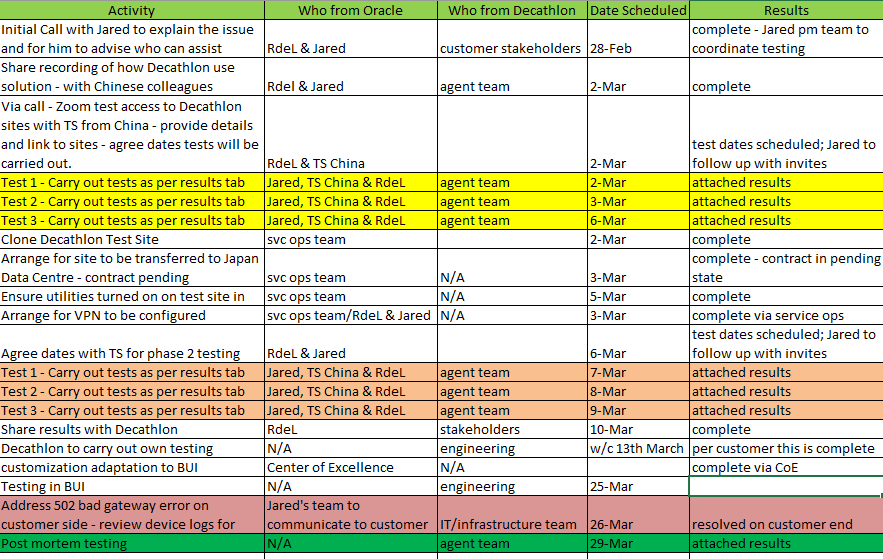
The move of datacenter would also be necessary as their agent team would benefit from a closer geographic proximity to where they were now working from. I worked this process with our contracts and hosting team to sign off on changes, schedule the move, test, ensure utilities were turned on and the VPN they desired was configured correctly for the new datacenter. An activity timeline with responsibilities was established to track updates.
Testing
I was able to confirm through performance testing the 3 key issues that would need to be addressed:
1. Utilizing a regional datacenter
2. Adopting from a Microsoft .NET deployment to a browser user interface thin client product deployment
3. Addressing/resolving the 502 bad gateway errors provided on the customer end that cropped up randomly on select devices/workstations, while also recommending endpoint management from a company/organization perspective on the customer end.
As initial testing was being completed, I was able to arrange to have the internal teams handling contracts address their contract situation so that the datacenter move could occur. During this time, I worked directly with our hosting team to schedule a date and time for the transfer to occur during low traffic hours for the customer. Immediately following transport of the site, a service operations team would assist in enabling all utilities and configuring the VPN setup.
Next Steps
Post-transport, further testing was conducted to confirm expected performance gains. While improvements were noted, I elected to continue to investigate the errors that would still randomly occur post-transport, while also reviewing the possibility of being able to assist the customer in adopting a thin-client version of the product. This would require considerable consulting work to adopt the various configured custom code the client had implemented, of which I was able to arrange for our internal consulting team to assist.
A final review with our network troubleshooting team identified the 502 errors the customer was routinely seeing, ruling out any single sign-on issues from our end and guiding the impacted agents to address these locally on their workstations. Device and endpoint management was recommended and put in place.
Results
Our final review with the customer detailed a significant performance increase.

Conclusion
The approach was a success overall. In being able to address two main problems the customer was having and also being able to identify another area of opportunity, I felt this went above and beyond the original ask from the customer. Being able to document these results and apply this approach to any similar customer scenarios that might come up in the future allows us to tell a success story with data-driven results that clients can have confidence in.
 Jared Ewert